

Inside your body, trillions of cells cooperate every second to keep you alive.
They communicate. They repair damage. They know when to grow. And they know when to die.
But sometimes, one cell stops listening.
One cell breaks the rules.
And if humanity cannot stop it in time, that single rebellious cell can destroy an entire human life.
We call it cancer.
The terrifying truth about cancer
Cancer is not an external monster invading the body. It begins from our own cells. That is what makes it so terrifying.
A healthy cell cooperates with the rest of the body.
A cancer cell becomes selfish.
It keeps multiplying even when it should stop. It refuses to die. It steals nutrients. It spreads into other organs.
And the hardest part?
Cancer is not one disease.
There are hundreds of types of cancer, each behaving differently. Some grow slowly. Others spread aggressively. Some hide from the immune system. Others mutate so quickly that treatments stop working.
Fighting cancer is like fighting an enemy that learns while you fight it.
How Humanity Is Trying to Defeat Cancer
For decades, scientists, doctors and researchers have been trying to attack cancer from every possible direction.
Not one strategy. Dozens of them.
Some already save millions of lives. Others are experimental. Some sound like science fiction.
But together, they form one of humanity’s greatest scientific battles.
1. Destroy the cancer directly
Method: Chemotherapy
Idea: Use powerful drugs to kill rapidly dividing cells.
Reality: Still one of the most common treatments in the world. It can save lives, but also damages healthy cells, which causes side effects like hair loss and weakened immunity.
Current status: Widely used, constantly improving.
2. Force cancer cells to self-destruct
Method: Apoptosis activation
Idea: Healthy cells contain a built-in “self-destruct program.” Cancer cells often disable it. Scientists try to reactivate it.
Current status: Already used in some modern targeted therapies.
Potential: Very promising because it attacks the internal weakness of cancer itself.
3. Stop cancer from multiplying
Method: Cell division blockers
Idea: Prevent cancer cells from reproducing.
Current status: Many existing drugs already do this, but cancer can evolve resistance.
4. Train the immune system to fight back
Method: Immunotherapy
Idea: Teach the body to recognize cancer as an enemy. For years, cancer often “hid” from the immune system. Immunotherapy tries to remove that invisibility cloak.
Current status: One of the biggest revolutions in modern medicine.
Challenge: It works dramatically in some patients — and barely at all in others.
5. Genetically engineer immune cells
Method: CAR-T therapy
Idea: Take a patient’s immune cells, genetically upgrade them, and send them back into the body to hunt cancer. Scientists describe it like “adding a GPS” to immune cells.
Current status: Already highly successful against several blood cancers. Researchers are now trying to make it work better for solid tumors.
Potential: Enormous.
Problem: Still extremely expensive and technically difficult.
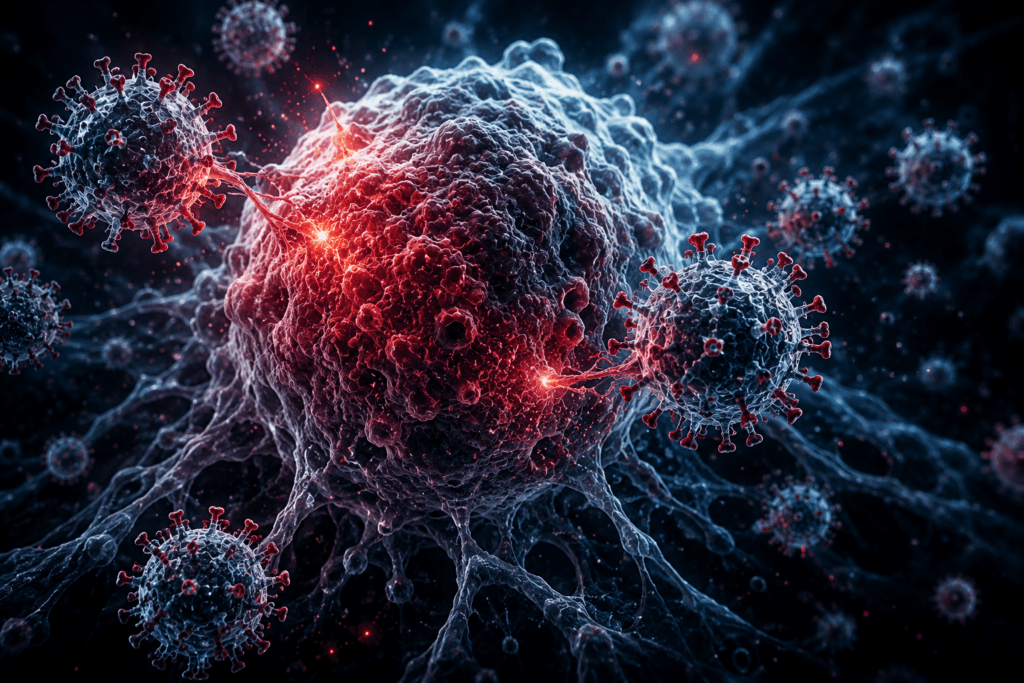
6. Use viruses against cancer
Method: Oncolytic viruses
Idea: Use specially engineered viruses that infect and destroy cancer cells while leaving healthy tissue mostly unharmed. Even more interesting: These viruses can also activate the immune system against the tumor.
Current status: One of the fastest growing experimental areas in cancer research. Multiple clinical trials are already underway.
Potential: Scientists consider this one of the most exciting future directions.
7. Starve the tumor
Method: Anti-angiogenesis
Idea: Tumors build their own blood vessels to steal nutrients. Scientists try to block that blood supply.
Current status: Already used in some cancer treatments.
Challenge: Cancer sometimes finds alternative ways to survive.
8. Destroy cancer with radiation
Method: Radiotherapy
Idea: Use high-energy radiation to damage cancer DNA.
Current status: A standard and highly important treatment worldwide.
Improvement: Modern systems are becoming more precise, reducing damage to healthy tissue.
9. Remove the tumor physically
Method: Surgery
Idea: Cut the cancer out before it spreads.
Current status: Still one of the most effective methods when cancer is detected early.
10. Attack precise weaknesses
Method: Targeted therapy
Idea: Instead of attacking everything, scientists identify specific molecular weaknesses in cancer cells.
Current status: Rapidly expanding.
Potential: Much more precise than traditional chemotherapy.
11. Heat the cancer
Method: Hyperthermia
Idea: Cancer cells can sometimes be weakened or damaged by high temperatures.
Current status: Used experimentally and in combination with other therapies.
Potential: Interesting support strategy, but not yet a universal solution.
12. Freeze the cancer
Method: Cryotherapy
Idea: Destroy tumors using extreme cold.
Current status: Already used for certain cancers and localized tumors.
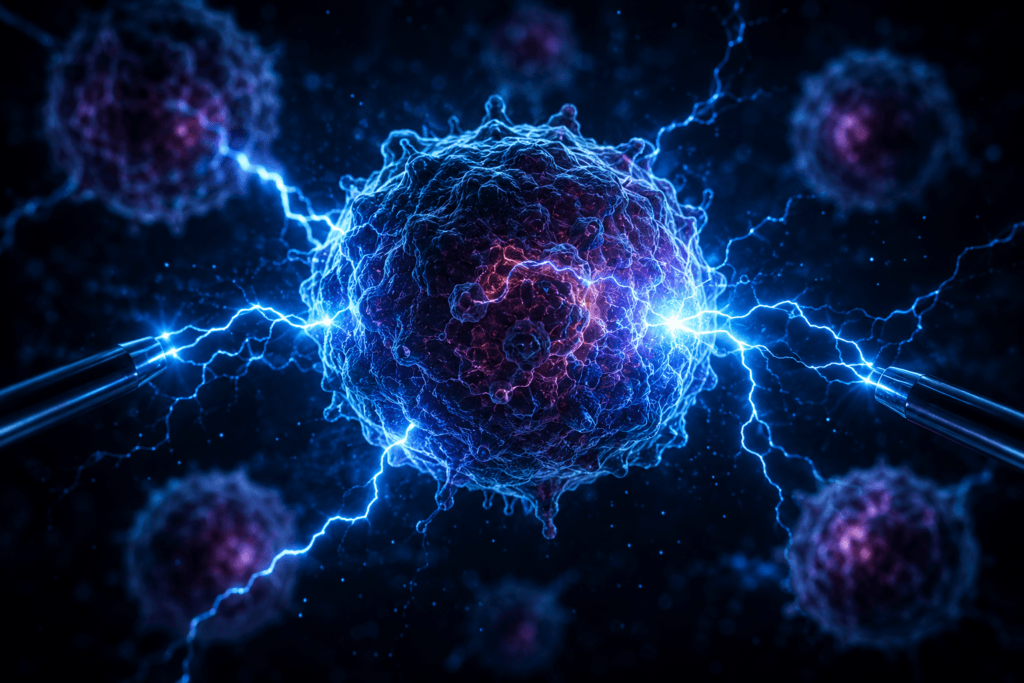
13. Use electricity and electric pulses
Method: Electroporation / Tumor Treating Fields
Idea: Electric fields may disrupt cancer cell function or help drugs enter cells more effectively.
Current status: Real medical technology already exists for some tumors, especially brain cancers.
Potential: Still developing.
14. Reprogram genes
Method: Gene therapy
Idea: Repair or modify the genetic instructions inside cells.
Current status: Early but rapidly advancing.
Potential: Could fundamentally change cancer treatment in the future.
15. Use nanotechnology
Method: Nanoparticles
Idea: Microscopic delivery systems carry drugs directly into tumors.
Current status: Already partially used in medicine.
Potential: Reduce side effects and increase precision.
16. Block cancer’s energy supply
Method: Metabolic therapy
Idea: Cancer cells consume energy differently from healthy cells. Scientists try to exploit this weakness.
Current status: Active research area.
17. Stop metastasis
Method: Anti-metastatic therapies
Idea: Prevent cancer cells from spreading through the body.
Current status: One of the hardest challenges in oncology.
Why it matters: Most cancer deaths are caused not by the original tumor, but by metastasis.
18. Change the tumor environment
Method: Tumor microenvironment research
Idea: Cancer survives because its surrounding environment protects it. Scientists try to change that environment.
Current status: Major modern research direction.
19. Combine multiple treatments
Method: Combination therapy
Idea: Attack cancer from several directions at once. For example: chemotherapy + immunotherapy; viruses + CAR-T cells; radiation + targeted drugs.
Current status: Increasingly common and often more effective than single treatments.
20. Artificial Intelligence
Method: AI-driven cancer research
Idea: Use artificial intelligence to analyze enormous amounts of medical data, detect patterns humans miss, and discover new treatments faster.
Current status: Already transforming diagnostics and drug discovery.
Potential: Massive.

But what if humanity still hasn’t asked the right questions?
This may be the most important part of the story.
For decades, cancer research has been driven mostly by laboratories, universities and pharmaceutical companies. And rightly so.
Science matters. Evidence matters. Reality matters.
But history also shows something important:
Many breakthroughs began with someone asking a question others ignored.
What if solving cancer requires not only better technology — but also new ways of thinking?
Not replacing science. Expanding the conversation around it.
Can the human mind influence the body?
This idea sounds almost uncomfortable to discuss. Because the internet is full of fake miracle cures and pseudoscience.
But beneath the nonsense lies a legitimate scientific question:
How deeply are the brain, immune system and body connected?
Scientists already know: stress affects immunity; emotions affect hormones; the nervous system influences inflammation.
The human mind cannot simply “command” a cancer cell to stop.
But researchers increasingly study the complex communication between brain, immune system, hormones, inflammation, disease.
Not magic. Biology.
And perhaps one day humanity will learn to influence these systems more precisely than we can today.
A Different Future
Maybe cancer will not be defeated by one miracle drug.
Maybe it will require:
- biology
- technology
- artificial intelligence
- engineering
- physics
- new questions
- collective human intelligence
For the first time in history, billions of people are connected.
Scientists. Doctors. Engineers. AI systems. Curious minds.
Maybe the future of defeating cancer will not come from thinking less scientifically.
Maybe it will come from humanity learning to think together differently.
That is the idea behind the PIQASO project.
Not replacing science. But opening space for new questions, new perspectives, and collective human thinking in humanity’s fight against cancer.
So now that you understand how cancer works — and how humanity is trying to fight it — what ideas, questions, or new perspectives come to your mind?
